Ecological parameters of mites associated with mango (Mangifera indica L.) cultivation in Ceiba del Agua, Artemisa, Cuba
Article Sidebar
Main Article Content
Abstract
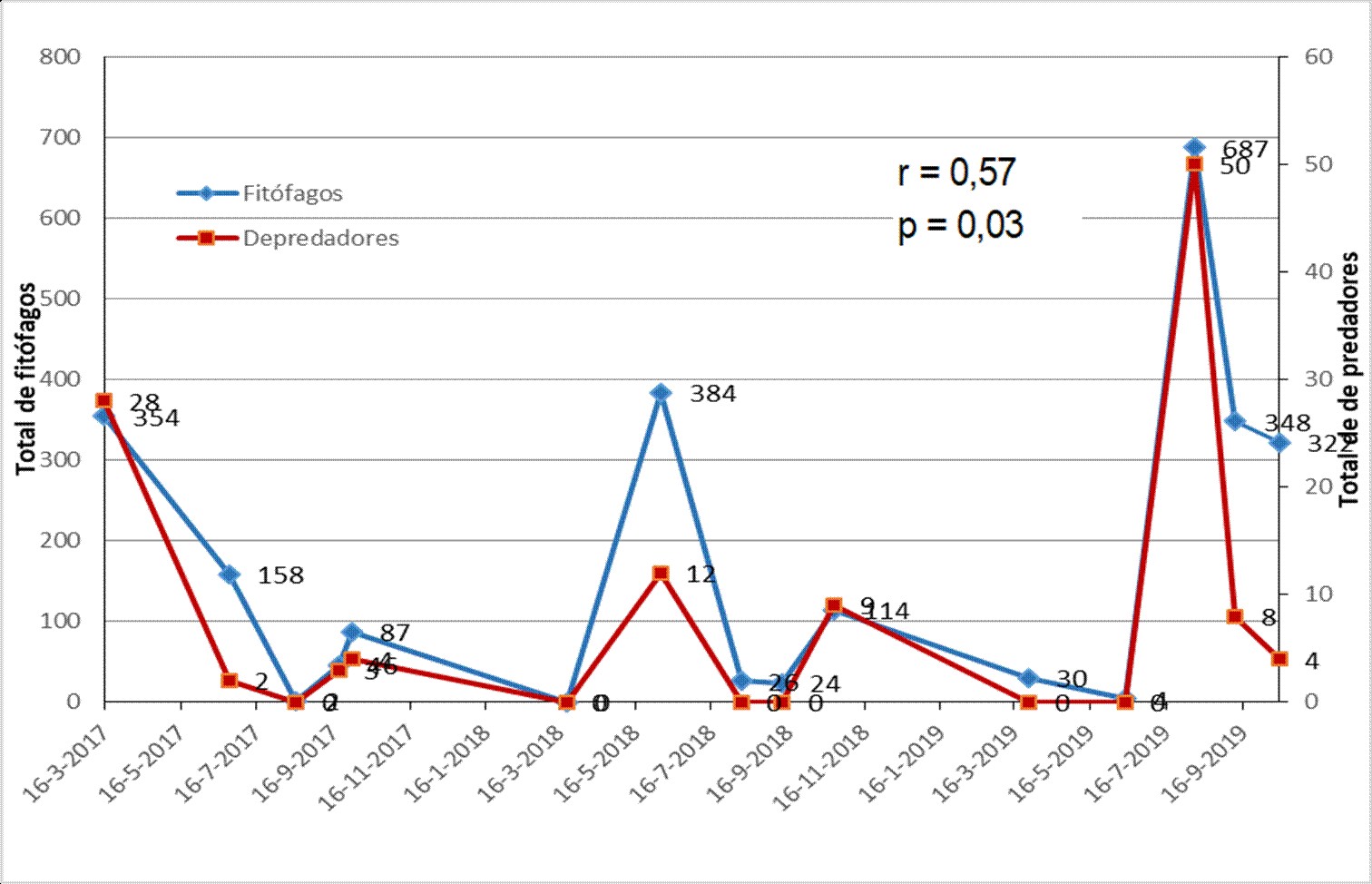
With the aim of determining ecological parameters of mites associated with mango (Mangifera indica L.) cultivation, a study was conducted from March 2017 to October 2019. Thirteen species, within nine families, were taxonomically identified using specialized keys: nine phytophagous (Aceria mangifera Sayed; Aceria kenyae Keifer; Spinacus pagonis Keifer; Tetranychus urticae Koch; Oligonychus spp.; Tarsonemus sp.; Polyphagotarsonemus latus Banks; Brevipalpus sp.; and unidentified Acaridae), three predatory (Bdella sp.; Agistemus sp.; Phytoseiulus macropilis Banks), and one species with varied feeding habits (Tydeus sp.). Abundance and frequency of each species were evaluated, leaf surface preference (adaxial vs. abaxial) was determined using the Wilcoxon test, biodiversity indices were calculated, and the densities of phytophagous and predatory mites were correlated. S. pagonis, with values exceeding 30% abundance and 40% frequency, was the most abundant and frequent species in the three years. The mites showed a significant preference for the abaxial leaf surface (Wilcoxon test; p<0.05 for the most frequent species). The correlation between phytophagous and predatory mites was low but significant (r=0.57; p=0.03), evidencing a functional response of P. macropilis. Biodiversity indices revealed low diversity (Shannon H’=1.27-1.72; ENS=3.56-5.59) and high dominance (Simpson D=0.20-0.37), associated with anthropogenic disturbances under conventional management systems. These results stress the need for ecological strategies to control S. pagonis, a key species due to its impact on mango cultivation.
Article Details

This work is licensed under a Creative Commons Attribution-NonCommercial 4.0 International License.
Aquellos autores/as que tengan publicaciones con esta revista, aceptan los términos siguientes:
- Los autores/as conservarán sus derechos de autor y garantizarán a la revista el derecho de primera publicación de su obra, el cual estará simultáneamente sujeto a la Licencia Creative Commons Attribution-NonCommercial 4.0 International (CC BY-NC 4.0) que permite a terceros compartir la obra, siempre que se indique su autor y la primera publicación en esta revista. Bajo esta licencia el autor será libre de:
- Compartir — copiar y redistribuir el material en cualquier medio o formato
- Adaptar — remezclar, transformar y crear a partir del material
- El licenciador no puede revocar estas libertades mientras cumpla con los términos de la licencia
Bajo las siguientes condiciones:
- Reconocimiento — Debe reconocer adecuadamente la autoría, proporcionar un enlace a la licencia e indicar si se han realizado cambios. Puede hacerlo de cualquier manera razonable, pero no de una manera que sugiera que tiene el apoyo del licenciador o lo recibe por el uso que hace.
- NoComercial — No puede utilizar el material para una finalidad comercial.
- No hay restricciones adicionales — No puede aplicar términos legales o medidas tecnológicas que legalmente restrinjan realizar aquello que la licencia permite.
- Los autores/as podrán adoptar otros acuerdos de licencia no exclusiva de distribución de la versión de la obra publicada (p. ej.: depositarla en un archivo telemático institucional o publicarla en un volumen monográfico) siempre que se indique la publicación inicial en esta revista.
- Se permite y recomienda a los autores/as difundir su obra a través de Internet (p. ej.: en archivos telemáticos institucionales o en su página web) antes y durante el proceso de envío, lo cual puede producir intercambios interesantes y aumentar las citas de la obra publicada. (Véase El efecto del acceso abierto).
References
FAO. FAOSTAT: Mango Production. Rome: FAO; 2023. Disponible en: http://data.apps.fao.org/catalog/dataset/crop-production-yield-harvested-area-global-national-annual-faostat Acceso: enero 2025.
Anaya B, García A. Cadena del mango en Santiago de Cuba: sondeo de demanda. Rev Econ Desarro. 2018;159(1):29-41.
Atencio R, Herrera JA, Aguilera V, Vásquez A. Perspectiva general de los ácaros fitófagos en mango y marañón. Rev Cient Guacamaya. 2024;9(1):8-24. doi: https://doi.org/10.5281/zenodo.7890123
Cabrera RI, Smith JA, Díaz M. Impacto del cambio climático en ácaros fitófagos del Caribe. Exp Appl Acarol. 2022; 86(3):321-335. doi: https://doi.org/10.1007/s10493-022-00700-4
Mango.org. Pests and Diseases in Mango [Internet]. 2020 [cited 2025 Nov 13]. Available from: https://www.mango.org
Rueda-Ramírez D, Paz-Núñez Y, Vásquez C. Climate-driven shifts in mite abundance in tropical mango systems. Exp Appl Acarol. 2021;85(2):87-101. doi: https://doi.org/10.1007/s10493-021-00676-6
de la Torre PE, Cuervo N. Actualización de la lista de ácaros (Arachnida: Acari) de Cuba. Rev Ibér Aracnol. 2019;34:102-118.
del Toro M, Duarte L, Caballero B, R Chico, H Rodriguez-Morell, L Cuellas-Yanes, et al. Primer informe de ácaros en Morus alba L. cultivar Gui Sang Yon 62 (morera) en Cuba. Rev. Proteccion Veg. 2019;34(1):1-4. http://opn.to/a/5CEgD
de la Torre PE, Manchado LL. Clave taxonómica para Bdellidae de Cuba. Fitosanidad. 2013;17(2):83-85.
Amrine JW, Stasny TA, Flechtmann CHW. Revised keys to world Genera of Eriophyoidea. West Bloomfield: Indira Publishing; 2003. 239 pp.
Moraes GJ, Britto EPJ, Mineiro JL, Halliday RB, Laing J, McMurtry JA. Phytoseiidae Database [Internet]. 2022 [cited 2025 Nov 13]. doi: https://doi.org/10.5281/zenodo.7890456
Jost L. Partitioning diversity into independent alpha and beta components. Oikos. 2007;116(12): 2124-2131.
Global Mango Research Alliance. Sustainable Pest Management in Organic Mango Systems. Rome. FAO. 2022.
Moraes GJ, Flechtmann CHW. Manual de Acarologia: Tetranychidae. Ribeirão Preto. Holos Editora. 2004. 180 pp.
Khan T, Babar T. Insect Pests of Mango: Identification, Biology, and Management Strategies. En: Syed Atif Hasan Naqvi, Shakeel Ahmad, Mukhtar Ahmed (Eds). Climate Change and Mango Production. 2025. Springer. 345-368 pp.
Tixier MS, Kreiter S, Douin M. Functional responses of Phytoseiulus macropilis to key mango pests. Biol Control. 2023; 185:105312. doi: https://doi.org/10.1016/j.biocontrol.2023.105312
Damasia DM, Bambharolia RP, Kachhela HR. Bio-efficacy of insecticides against hopper and thrips in mango. Pestic Res J. 2025;37(1):75-79. doi: https://doi.org/10.5958/2249-524X.2025.00012.2
Masson A, Bryssinck S. The structure and diversity of the animal communities in peat lands reeds warp. J Zool. 1974;179: 289-302.
Conover WJ. Estadística práctica no paramétrica. Nueva York. John Wiley & Sons. 1999. 584 p.
Shannon CE, Weaver W. The Mathematical Theory of Communication. Urbana. Univ Illinois Press; 1949.
Simpson EH. Measurement of diversity. Nature. 1949;163:688. doi: https://doi.org/10.1038/163688a0
InfoStat [software]. Version 2023. Córdoba: Grupo InfoStat; 2023.
Castro LM, Herrera JA, Díaz M. Pyrethroid resistance in Caribbean mite pests: para gene mutations and management implications. Sci Rep. 2024;14:56789. doi: https://doi.org/10.1038/s41598-024-56789-6
FAO. Manual de liberación de depredadores en cultivos tropicales. Rome: FAO; 2021.
Tixier MS, Kreiter S, Ferrero M. Climate-resilient biocontrol strategies in tropical fruit systems. Agron Sustain Dev. 2025; 45(2):112. doi: https://doi.org/10.1007/s13593-025-00987-1
Rodríguez M, D Hernández, M Borges, JL Rodríguez. Biodiversidad de artrópodos benéficos en una colección de anonáceas en Artemisa, Cuba. Fitosanidad. 2016. 20(1).