Risk factors associated with bovine rabies cases and potential distribution to vulnerable areas in Cajamarca, Peru
Article Sidebar
Main Article Content
Abstract
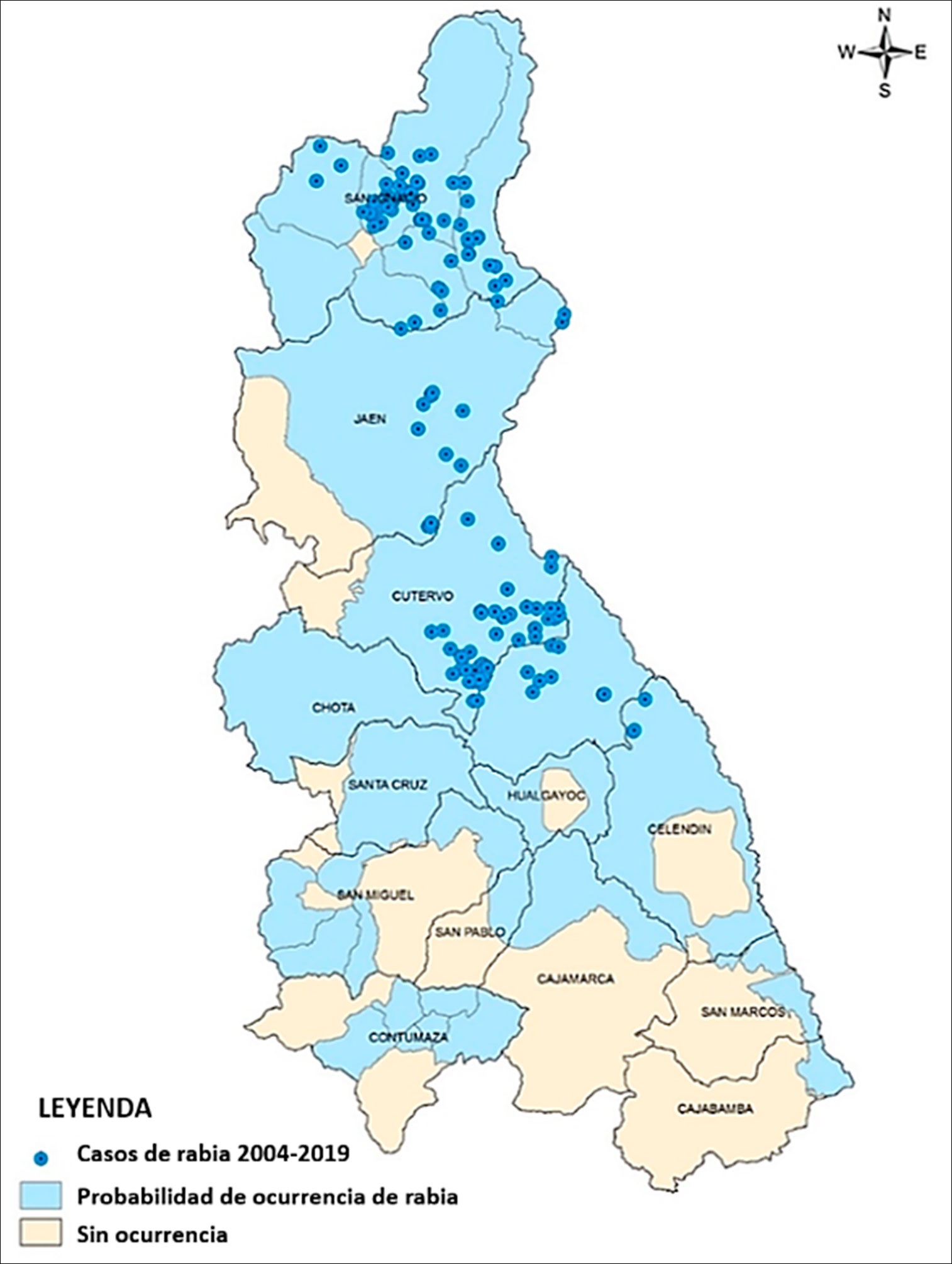
Wildlife-origin bovine rabies is endemic in South America, with the common vampire bat (Desmodus rotundus) being its primary transmitter. Climate change has altered its spatial distribution, leading to an increase in positive cases of the disease. This research aimed at evaluating the risk factors associated with the occurrence of bovine rabies cases and predicting the potential distribution of the disease into vulnerable areas of Cajamarca region, Peru. A retrospective analysis was conducted on 172 suspected cases from 2004 to 2019, of which 132 were confirmed as rabies-positive using the direct immunofluorescence technique. Each variable was qualitatively categorized into risk ranges. The data were processed using multivariate statistical analysis and the Chi-square test to determine the factors associated with rabies cases. The potential distribution was based on an ecological niche modelling, utilizing records of positive rabies occurrences and geo-environmental information layers. The risk factors identified were: temperature (p = 0,033), altitude (p = 0,021), distance to Desmodus rotundus roosts (p < 0,001), and relative humidity (p = 0,001). The probability of new cases occurring was simulated for 78,12% of Cajamarca region.
Article Details

This work is licensed under a Creative Commons Attribution-NonCommercial 4.0 International License.
National Center for Animal and Plant Health (CENSA)References
Krebs JW, Wilson ML, Childs JE. Rabies: Epidemiology, Prevention, and Future Research. J Mammal [Internet]. 1995;76(3):681-94. Disponible en: http://www.jstor.org/stable/1382740
Meske M, Fanelli A, Rocha F, Awada L, Soto PC, Mapitse N, et al. Evolution of Rabies in South America and Inter-Species Dynamics (2009-2018). Trop Med Infect Dis [Internet]. 2021;6(2):98. Disponible en: https://www.mdpi.com/2414-6366/6/2/98
Benavides JA, Valderrama W, Recuenco S, Uieda W, Suzán G, Avila-Flores R, et al. Defining New Pathways to Manage the Ongoing Emergence of Bat Rabies in Latin America [Internet]. Vol. 12, Viruses. MDPI AG; 2020 [citado 28 de febrero de 2025]. Disponible en: https://doi.org/10.3390/v12091002
Soler-Tovar D, Escobar LE. Rabies transmitted from vampires to cattle: An overview. PLoS One. 2025;20(1).
Ulloa-Stanojlovic FM, Dias RA. Spatio-temporal description of bovine rabies cases in Peru, 2003-2017. Transbound Emerg Dis [Internet]. 2020 [citado 28 de febrero de 2025];67(4):1688-96. Disponible en: https://doi.org/10.1111/tbed.13512
SENASA. Situación Epidemiológica de la rabia en herbívoros en la región de Cajamarca. Cajamarca; 2019.
Moura Neves JM, Silva Belo V, Souza Catita CM, Alves de Oliveira BF, Pereira Horta MA. Modeling of Human Rabies Cases in Brazil in Different Future Global Warming Scenarios. Int J Environ Res Public Health [Internet]. 2024 [citado 28 de febrero de 2025];21(2). Disponible en: http://dx.doi.org/10.3390/ijerph21020212
Arias Caicedo MR, De Arruda Xavier D, Arias Caicedo CA, Andrade E, Abel I. Epidemiological scenarios for human rabies exposure notified in Colombia during ten years: A challenge to implement surveillance actions with a differential approach on vulnerable populations. PLoS One [Internet]. 2019 [citado 28 de febrero de 2025];14(12). Disponible en: https://doi.org/10.1371/journal.pone.0213120
Rojas-Sereno ZE, Streicker DG, Medina-Rodríguez AT, Benavides JA. Drivers of Spatial Expansions of Vampire Bat Rabies in Colombia. Viruses [Internet]. 2022 [citado 28 de febrero de 2025];14(11). Disponible en: https://doi.com/2414-6366/6/2/98
INEI. Resultados definitivos del IV Censo Nacional Agropecuario. 2013.
INEI. Censos 2017: departamento de Cajamarca cuenta con 1 341 012 habitantes. 2018.
SENAMHI. Datos hidrometeorológicos en Cajamarca por cada estación según día, año y mes. 2021.
Quintana H, Pacheco V. Identificación y distribución de los murciélagos vampiros del Perú. Rev Peru Med Exp Salud Publica [Internet]. 2007 [citado 28 de febrero de 2025];24(1):81-8. Disponible en: https://www.redalyc.org/articulo.oa?id=36324111
Pulgar J. Geografía del Perú: ocho regiones naturales del Perú. Editorial Universo. Lima; 1981.
Maldonado-Arias DF, Guamán-Rivera SA, Mira-Naranjo JM, Ortiz-Naveda NR. Bovine rabies cases in Ecuador: a retrospective cross-sectional observational study (2007 to 2020). Brazilian Journal of Biology [Internet]. 2024 [citado 28 de febrero de 2025];84. Disponible en: https://doi.org/10.1590/1519-6984.279112
Johnson N, Aréchiga-Ceballos N, Aguilar-Setien A. Vampire bat rabies: Ecology, epidemiology and control. Viruses [Internet]. 2014 [citado 28 de febrero de 2025];6(5):1911-28. Disponible en: https://doi.org/10.3390/v6051911
Mantovan KB, Menozzi BD, Paiz LM, Sevá AP, Brandão PE, Langoni H. Geographic Distribution of Common Vampire Bat Desmodus rotundus (Chiroptera: Phyllostomidae) Shelters: Implications for the Spread of Rabies Virus to Cattle in Southeastern Brazil. Pathogens [Internet]. 2022 [citado 28 de febrero de 2025];11(8). Disponible en: https://doi.org/10.3390/pathogens11080942
Pineda ME, Vidal Cárdenas EM, Callapiña Enríquez EH, P AA. Association between geographical altitude and incidence of wild rabies in cattle in the Apurimac region (2004-2015). Revista de Investigaciones Veterinarias del Peru [Internet]. 2021 [citado 28 de febrero de 2025];32(4). Disponible en: http://dx.doi.org/10.15381/rivep.v32i4.19270
Bárcenas-Reyes I, Loza-Rubio E, Zendejas-Martínez H, Luna-Soria H, Cantó-Alarcón G, Milián-Suazo F. Comportamiento epidemiológico de la rabia paralítica bovina en la región central de México, 2001-2013. Revista Panamericana de Salud Pública [Internet]. 2015 [citado 28 de febrero de 2025];38(5):392-402. Disponible en: https://doi.org/10.4081/gh.2019.805
Cárdenas Contreras ZL. Análisis espacio temporal de la rabia bovina de origen silvestre en Colombia (2005-2014) [Internet]. [Barcelona]: Universidad Autónoma de Barcelona; 2017 [citado 28 de febrero de 2025]. Disponible en: https://ddd.uab.cat/record/185216
Greenhall AM, Joermann G, Schmidt U. Desmodus rotundus. Mammalian Species [Internet]. 1983; 202:1-6. Disponible en: https://academic.oup.com/mspecies/article/doi/10.2307/3503895/2600261
Barquez R, Perez S, Miller B, Diaz M. Desmodus rotundus, common Vampire Bat. [Internet]. The IUCN Red List of Threatened Specie 2015. 2015. Disponible en: http://dx.doi.org/10.2305/IUCN.UK.2015-4.RLTS.T6510A21979045.en
Zarza H, Martínez-Meyer E, Suzán G, Ceballos G. Geographic distribution of Desmodus rotundus in Mexico under current and future climate change scenarios: Implications for bovine paralytic rabies infection. Veterinaria Mexico OA. 2017;4(3).
Ortega-Sánchez R, Bárcenas-Reyes I, Luna-Cozar J, Rojas-Anaya E, Cuador-Gil JQ, Cantó-Alarcón GJ, et al. Spatial-temporal risk factors in the occurrence of rabies in Mexico. Geospat Health. 2024;19(1).
Briceño-Loaiza C, Fernández-Sanhueza B, Benavides-Silva C, Jimenez JY, Rubio A V., Ábalos P, et al. Spatial clusters, temporal behavior, and risk factors analysis of rabies in livestock in Ecuador. Prev Vet Med [Internet]. 2024 [citado 28 de febrero de 2025];226. Disponible en: https://doi.org/10.1016/j.prevetmed.2024.106188
Perks SJ, Goodenough AE. Abiotic and spatiotemporal factors affect activity of European bat species and have implications for detectability for acoustic surveys. Wildlife Biol [Internet]. 2020 [citado 28 de febrero de 2025];(2). Disponible en: https://doi.org/10.2981/wlb.00659
Orlando SA, Panchana VF, Calderón JL, Muñoz OS, Campos DN, Torres-Lasso PR, et al. Risk Factors Associated with Attacks of Hematophagous Bats (Desmodus rotundus) on Cattle in Ecuador. Vector-Borne and Zoonotic Diseases [Internet]. 2019 [citado 28 de febrero de 2025];19(6):407-13. Disponible en: https://doi.org/10.1089/vbz.2017.2247